On view in 2026:
Through May 2027 at the Fitchburg Art Museum near Worcester, Mass.
Kaleidoscope: 100 Years of Collecting for Our Community!
The second in a series of exhibitions marking FAM’s Centennial, and features hundreds of artworks from our Permanent Collection, ranging across the globe, human history, and artistic media and movements.
Featuring old favorites, new acquisitions, and rarely before seen artwork, Kaleidoscope juxtaposes it all, allowing visitors to create their own visual, psychological, intellectual, and spiritual meanings. The exhibition features over five-hundred artworks from the Museum’s Permanent Collection. Kaleidoscope is a celebration of both the power of art, and the variety and quality of the collection that we hold in trust for you.
Through July 19, 2026 at The MFAH in Houston
A History of Photography and the Everyday
Including work by Philip Lorca diCorcia, Alec Soth and more, and installed in the dedicated photography galleries of the Nancy and Rich Kinder Building, A History of Photography and the Everyday explores the outsize role played by the medium in our daily lives. From cell phones filled with snapshots, to media images, photographs are everywhere. Despite this saturation, photographs still have the power to reveal new truths, encourage us to rethink the familiar, and elevate humble scenes of everyday life to new realms of beauty and artistry. Drawn from the museum’s permanent collection, this exhibition features the work of more than fifty photographers from across the globe and includes both new acquisitions and longtime treasures spanning the history of the medium and reparenting many genres.
Ongoing at SCSU School of Business in New Haven, CT
Art in Public Spaces Program, supported by CT State Office of the Arts
The Connecticut Office of the Arts, Department of Economic and Community Development manages the Art in Public Spaces program and the Connecticut Artists Collection. Browse the public art collections of artwork located at various state institutions across Connecticut here
Through May 2026 at The Museum of Sex in Miami
Hard Art: Unruly Selections from the Beth Rudin DeWoody Collection
Since acquiring her first drawing in 1969 at the age of 17, Beth Rudin DeWoody has amassed one of the largest collections of contemporary art in the world. Her passion for art is deeply personal and inclusive—driven not by trends or the market, but by a genuine connection to the bold and authentic.
Guided by intuition, DeWoody embraces the subversive and seeks art that challenges convention while highlighting underrepresented voices. In celebrating the unconventional, she continually redefines what it means to be a true patron of contemporary art. Given her fearless and adventurous approach to collecting, it is only natural that the erotic holds a significant place in her collection.
The show brings together works in various media, from the 1930s to the present, that confront, provoke, and subvert—often through the lens of the body or desire, but never limited to it. Sexuality serves as a conduit for broader themes, including anti-war activism, redefinitions of the historical odalisque, and explorations of power, intimacy, and the human–posthuman condition.
The exhibition is a collaboration between the Beth Rudin DeWoody Collection and the Museum of Sex, two institutions united in their dedication to supporting the artist’s voice and championing uncensored expression, however explicit. The exhibition includes artists and content that has been historically censored. While some artists have entered the canon, much of the content remains unacceptable in the mainstream. In this space, all is celebrated as a vital contribution to the cultural conversation.
Through April 11, 2026 in the Antonio Marras Showroom in Milan
A solo show, Fantasies, curated by Metronom Projects, featuring works from the 2009 Damiani book of the same name, interspersed on ancient walls among the fashion on display to coincide with the Photo Vogue festival.
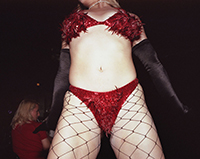
What happens behind the scenes of a burlesque stage? What stories unfold in hidden spaces, far from the audience’s gaze?
The series Fantasies by Lisa Kereszi offers a compelling response. Developed between 1999 and 2005, the project explores, through photography, the world of American nightclubs. The protagonists are burlesque dancers captured in the moments before or after their performances: shimmering bodies wrapped in lavish and revealing costumes, carefully constructed poses, theatrical gestures, fragments of sensuality set against interiors that are often modest, at times even dilapidated. It is precisely within this tension—between the seductive artifice of the stage and the raw reality of the surrounding spaces—that the narrative strength of the work emerges. Kereszi does more than document; she constructs suspended, deliberately enigmatic images that invite viewers to broaden their visual horizons and to reflect on what remains outside the frame. Details and fragments become central elements in a visual narrative that transforms places commonly regarded as marginal or seedy into unexpectedly familiar settings.
Posted on 27 April 2026